I love dogs. I love the cover–the sheer joy on the dog’s face. I love that the essays are written by well-known writers, some of whom I’ve read. I love that no one is ever too famous to be bowled over by the mysterious nature of a dog, even one with frustrating quirks!
What is this book about?
Dogs: rescue dogs, puppies, big dogs, little dogs, working dogs, pampered dogs, dogs with big personalities, shy dogs. Dogs who come into our worlds and make our lives better. Dogs who need our help to make their lives better.
Why did I like this book?
I laughed. I cried. I sighed. I nodded my head in complete understanding at least once as I read each essay, recognizing at least one trait that could be found in one of the many dogs I’ve known. Each essay is a delight–a well-written, mini-philosophical exploration of our relationships with dogs.
The best way to read this book?
With a dog!
I’d been writing in my office, when my grand-dog Nellie entered with a toy in her mouth, her whole body wiggling, her tail furiously wagging. My interpretation: “Hey, Nana, you’ve been writing long enough. Come spend time with me and I’ll give you this toy.” I followed her out of the office and picked up The Best Dog in the World. I sat on the couch and invited her up. Content, she curled up into a tight ball.
I read the last few essays with her curled up by my side, the warmth of her body radiating into mine, my left hand gently resting on her back because human touch is important to her. After all, she’s a Vizsla: aptly nicknamed the Velcro dog.
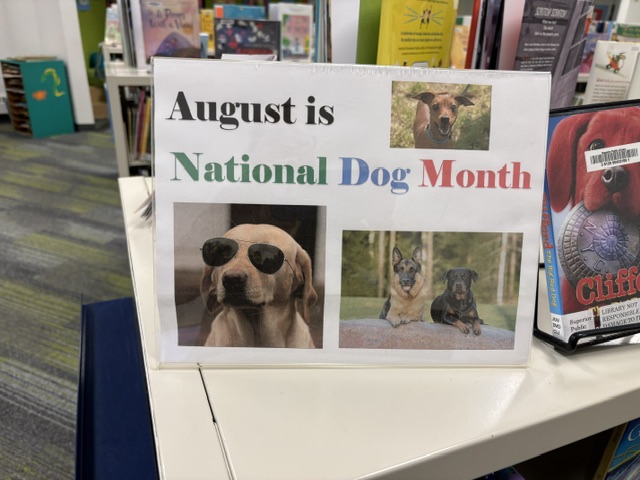
Our local library’s display of dog literature!
AND TO CELEBRATE NATIONAL DOG MONTH . . .
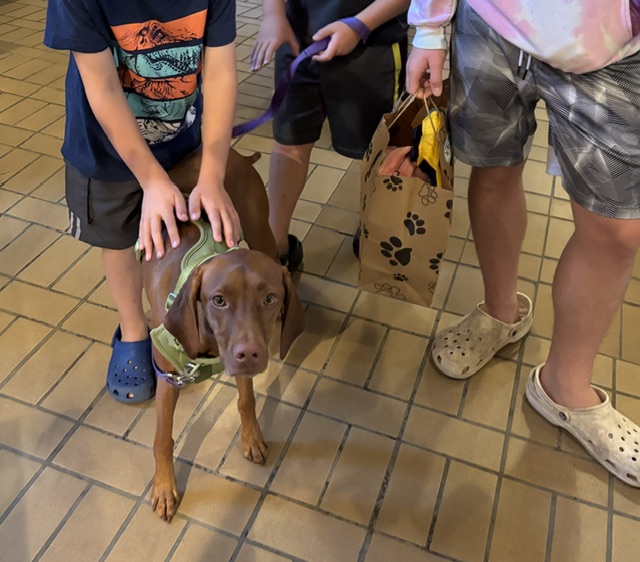
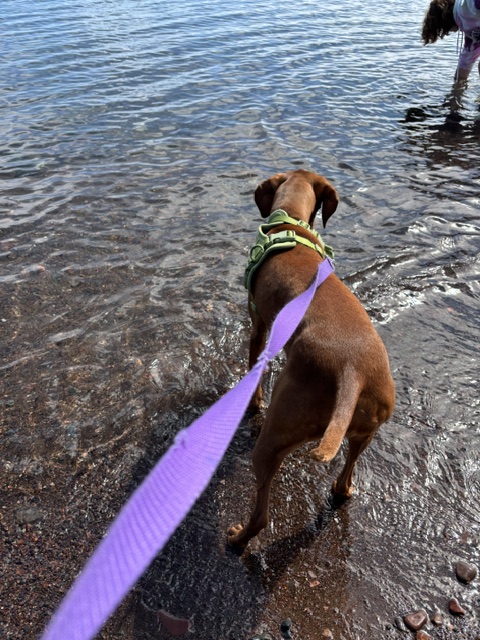
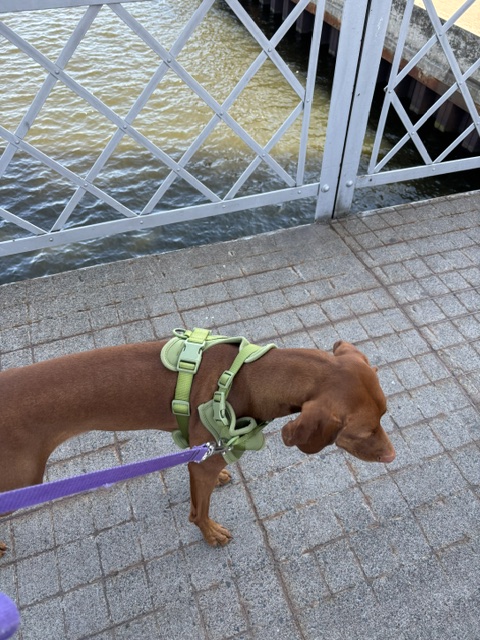
Nellie had a trip to Canal Park and Fitgers in Duluth, both dog-friendly places. She started with a shopping spree at A Place for Fido, located in Fitgers. She picked out a dog flotation device for her upcoming water adventures, a pink flamingo stuffy, and a bag of treats. Next, she pranced along the Duluth Lakewalk with my grandkids and me. She dipped her toes in Lake Superior, received numerous compliments about her pretty looks, had a bit of vanilla ice cream, and walked with us across the Aerial Lift Bridge.
Cornerstone Press at the University of Wisconsin-Stevens Point accepted my manuscript of short stories in December 2024, a wonderful Christmas present for me! They gave me a publishing date of February 2027, a time somewhere in the distant future, which felt light-years away, but comforting because it gave me plenty of time to prepare. I signed a contract, reordered my stories, and sent Cornerstone an updated manuscript.
Then came the first lull, a point in my journey to publication when not much happened.
About eleven months after acceptance, I asked authors for book blurbs. When the blurbs began arriving, my book felt real again. I was overjoyed by the complimentary words written by wonderful writers who said things about my stories that I felt but struggled to put into words whenever someone asked me to describe them.
Then came another lull.
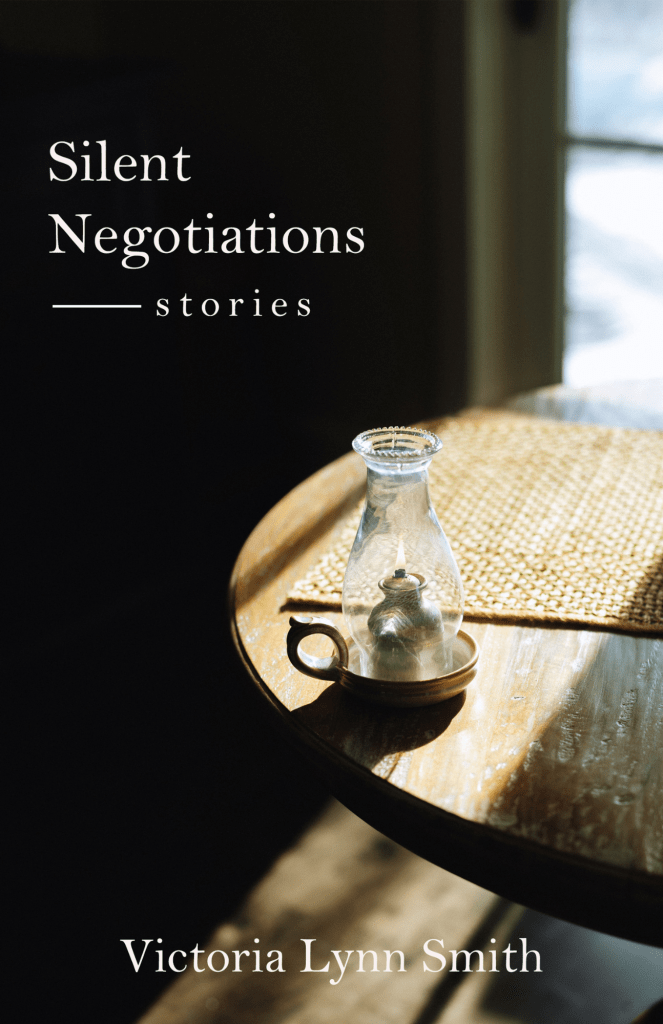
But at the end of April 2026, a graphic designer from Cornerstone sent me an email with eight different wonderful designs, and each one had something I loved. But the more I thought about them, the more I realized that none of them quite fit my stories. I talked to my nephew who is a photographer and who has read my stories, and he sent a selection of photos. His photo with the lamp on the table and the sunlight streaking into the room became my favorite.
For the next six weeks, I showed friends, coworkers, and fellow writers photographs of cover designs. “Which ones do you like best? I’d ask. Always the photo with the lamp on the table was in the top three, usually a person’s first or second pick.
I asked my graphic designer to please use photo with the lamp on the table. She cropped some distracting objects from the right of the photo, making the image stronger. Then she presented me with several font options. After we agreed on the font selection and size, she sent the photo off to the editor-in-chief who, wanting to give the cover a sense of movement, added the long dash in front of the word stories. A perfect touch! It’s amazing how a small detail can make a big splash!
The third lull, lasting four weeks, was broken by meeting the editor who is in charge of the team who will be working with me and my book. We had our first meeting via Zoom, and I feel she’s a perfect fit for me. Our next step is content edits. From here on in, I’m not sure there are going to be too many lulls in the march to publication.
Oh, and I’m getting a puppy in December or January. A puppy and a book! One of them will give kisses. One of them will fulfill a life-long dream. Both of them will keep me up at night for a while. O joyful new beginnings.
I read The Gales of November: The Untold Story of the Edmund Fitzgerald by John U. Bacon, and loved it. (Click on the title to read my review of that book and scoll down a bit.) Also, years ago I read an article about the Halifax explosion, and I wanted to learn more about it. For those of you who read my blog regularly, you know I have a thing for shipwreck disasters. This one is unique because when the Mont-Blanc exploded, more than one square mile of land in and around Halifax was leveled.
What is this book about?
In December 1917, World War I raged in Europe. The unprecedented scale of the Great War created an insatiable hunger for soldiers, weapons, and other materials, many of which funneled through the Port of Halifax in Canada before sailing to Europe. In November 1917, Lenin told the Russian people their country would soon withdraw from the war. The Allies knew the Germans could then shift their troops and supplies from the Eastern Front to the Western Front. In an attempt to fend off the impending German onslaught on the Western Front, the Allies increased shipments of weapons and soldiers to Europe. In doing so, they began to employ substandard ships, like the Mont-Blanc, then precariously overload them with volatile explosives. In order to move shipments quickly, certain safeguards in Halifax Harbor were relaxed, creating a mentality that put speed and tonnage above safety. And for a while, they got away with it.
But on December 6, 1917, a combination of arrogance, lack of communication, and disregard for safety regulations resulted in the most destructive human-made explosion ever experienced, one that wouldn’t be surpassed until the bombing of Hiroshima in 1945. The explosion killed about 2,000 people, wounded another 9,000 people, and left nearly 25,000 people with either severely damaged homes or no homes at all.
Why did I like this book?
Bacon skillfully grapples with an overwhelming large-scale catastrophe that impacted about 40,000 people. The noise and aftershocks of the explosion were felt up to two hundred miles away. And while Bacon clearly describes the enormity of the disaster, the aspects that led to it, and the massive humanitarian relief efforts that followed, he also creates a narrative that conveys how it impacted individual people.
John Bacon is a wonderful writer. Evidenced by his careful research, it’s obvious that he cares a great deal about this historical tragedy and the people whose lives were forever impacted by it. Even though the explosion occurred over one hundred years ago, Bacon’s book delivers a cautionary tale — a timeless message against arrogance and overconfidence. He also reveals that in the face of an overwhelming calamity, people put aside their differences and pulled together in an uplifting story of humanity.
[Note: To read more about John U. Bacon and other nonfiction books written by him, including books about sports, click here.]
WWII has completely upended the life of Roza Mészáros, a young Hungarian countess. Her life as a privileged member of Hungarian society is over, and after years of practice and training, Roza’s dream of becoming a ballerina is also over.
Shortly after the war ends, Roza meets Joe, a kind and loving American soldier, and they fall in love. Before he ships back to Minnesota, he proposes to her. It takes her almost two years to run the maze of red tape before she is able to join Joe in America.
When Roza arrives at the train station in St. Paul, Minnesota, Joe isn’t there to meet her. She learns he has married someone else only a few months before her arrival. She is heartbroken, but she is also scared. She has only two weeks to marry or she will be deported back to Hungary, where she would be labeled an American sympathizer by the Soviets who now control Hungary.
Facing the possibility of imprisonment or death at the hands of the Soviets, Roza makes a bold decision. With the help of a popular Minnesota newspaper columnist, Roza advertises for a husband. After meeting a handful of the over one thousand men who proposed to her by letter, she casts her fate with Finn Ericksen, a WWII veteran.
Why did I read this book?
Somewhere I read a brief summary about this book and thought, “Sounds like an interesting story.” But I have a large TBR pile, so I didn’t rush out and buy it. I forgot about the book until I read that one of our local bookstores was hosting a talk with Loretta Ellsworth about the book. I like to hear authors talk about their journeys as writers and why they wrote a particular book, so I went to meet Ellsworth.
Once I learned that The Jilted Countess was based on a true story, I was hooked. Only the very beginning of the book is based on facts: the Countess was jilted, she did advertise for a husband, and she did marry one of the men who responded. Once the couple married, however, they shunned all publicity. Ellsworth tried to find out what happened to the real-life couple, but couldn’t. So, she used her imagination to create a wonderful historical fiction romance novel.
Why did I like this book?
It’s a well-written, character-driven love story that touches the heart without being sappy. It’s sort of a reverse fairy tale — the Countess is in search of a commoner, instead of a prince, who can save her from a perilous fate. She finds one, but will there be a happy ever after?
Wonderfully paced with an engaging plot, the book is a page turner. I stuck my nose in the book on a two-and-a-half-hour road trip to a golf shop where my husband would be fitted for a set of golf clubs. After each chapter or so, I’d close the book for a couple of minutes and say something to him. He likes it when I keep him company on road trips, so I usually don’t read, but I couldn’t resist returning to the pages of Roza’s life.
Once we arrived at the golf shop, my husband signed in for his appointment, and I was free to read without feeling guilty. I asked an employee if they had a small lounge area where I could sit and read while my husband had his fitting, but they didn’t. I wandered around, thinking I’d have to find a place to sit on the floor. But tucked at the end of a small hallway, I found a padded bench in an area that housed golf shoes. I sat and read for the next hour and a half, finishing the book.
At times my eyes welled up with tears, and I had to fish in my purse for a tissue to dab my eyes. A couple of times people wandered into the shoe area, and I’d stop reading and ask if they wanted to use the bench to try on shoes, but thankfully, no one did.
Ellsworth dedicated this novel to a friend of hers who told her to write the story. I’m glad she listened to her friend.
In the summer of 1976, I was a seventeen-year-old who would soon travel to Europe for a month. This meant I would miss America’s 200th birthday bash. By the time our group of high school students and chaperones flew out of Billy Mitchell Airport in Milwaukee in late June, the buzz surrounding the Bicentennial hummed in the air. Having studied both Spanish and German in high school, I was excited to see Europe, but I was also sad about missing the Bicentennial. The next big celebration would be America’s 300th birthday, and I knew I’d never live to see that one. I didn’t know that a semiquincentennial celebration would be a big deal: I’d never even heard of the word.
On July 4, 1976, when our tour group arrived in Rome, we were given a choice about how we wanted to spend the Fourth of July. We could attend a professional ballet performance or an evening picnic followed by fireworks sponsored by the American Embassy. I chose the picnic and fireworks because if I couldn’t be in the States for the Bicentennial, I could at least be with a group of patriotic Americans eating scrumptious picnic food and watching extravagant fireworks.
It was the worst Fourth of July celebration I ever attended. The food was second-rate, the fireworks were average, and the park was peppered with litter. I grew up inspired by Lady Bird Johnson and the Keep America Beautiful campaign. Every spring and fall my sisters and I pulled our red wagon up and down our road and picked garbage out of the ditches. I yelled at friends who threw litter out of car windows. The inconsiderate Americans who couldn’t put their trash in the garbage can embarrassed me, and before the fireworks started, I regretted skipping the ballet.
At the time I saw the embassy picnic as a lackluster celebration that didn’t match the significance of two centuries of democracy. In hindsight it strikes me that American democracy has a long history of casting aside many of its citizens, like the discarded rubbish I saw dropped by patriotic Americans who somehow felt entitled to litter someone else’s park. Patriotism isn’t about eating a hotdog or watching fireworks or boasting about being the absolute best and greatest ever. Patriotism should be about loving a country that embraces equality, justice, and opportunity for all. Patriotism should be about learning from your country’s mistakes. Patriotism should never be about blindly following leaders who trade in rhetoric that elevates one group of people at the expense of other groups of people.
Years later my mother-in-law took me to my first ballet, The Nutcracker. I loved everything about it—Tchaikovsky’s music, the graceful dancers, the whimsical costumes, the enchanted scenery. And once again, I regretted missing the ballet in Rome on July 4, 1976.
But I realize that by choosing to attend the Bicentennial celebration at a park in Rome, littered with hot dog wrappers, chip bags, paper plates, wads of napkins, and plastic silverware, I learned something about patriotism: It’s okay to love your country, but don’t allow it to toss trash. Let’s be kind. Let’s remember democracy is inclusive. Choose the beauty of the ballet.
Happy Fourth of July.
[A version of this piece first appeared in Tales of Travel, an anthology published by the University of Minnesota-Duluth in 2023. It was part of a longer essay titled “European Tour 101.]
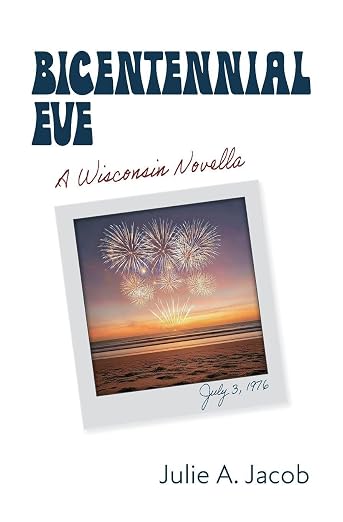
It’s 1976, the eve of America’s 200th birthday. As communities across the country prepare to celebrate the Bicentennial, three generations of people living in a small town in southeastern Wisconsin explore what their own personal independence means to each of them.
Seventy-three-year-old Kitty Barrett longs to fulfill a childhood dream, but worries her family will think she’s too old. Kitty’s daughter Claire, in her early 40s, wants more out of life than domestic chores and her ten-hour-a-week job at the library. Claire’s daughters have dreams of their own. Grace is torn between the boy she loves and spending her junior year of college in France, and thirteen-year-old Skye hopes for a romance with a fickle-hearted classmate named Zack. Kitty’s other daughter Vivian, in her early 50s, tentatively rekindles a romance with a high-school sweetheart.
Silently hovering over the eve of their Bicentennial celebration is the memory of Vivian and Claire’s brother, Mike, who was killed during WWII in 1944. As the stories of Kitty’s and her family’s pursuit of happiness unfold, it’s apparent that even though thirty-two years have passed since Mike’s death, the sorrow of his untimely passing has cast a lingering shadow over the lives of Kitty, Claire, and Vivian.
Why did I read this book?
I read Julie Jacob’s collection of essays, Two States of Single: Essays of Love, Family, and Living Solo, and I loved it. After meeting Jacob at the Wisconsin Writers Association Conference in October 2024, I read her collection of essays a second time and loved it again. So, when I learned that her novella had been accepted for publication, I was excited.
Also, I was seventeen years old in 1976, and I remember the anticipation and excitement surrounding the Bicentennial. Although I would be on an adventure in Rome on July 4, 1976, at the time I felt sad about missing the Bicentennial celebration in the States. Reading Jacob’s book gave me a chance to travel back in time to my own southeastern Wisconsin hometown. I could experience the Bicentennial through the eyes and actions of her characters who are ordinary people dealing with the same type of issues that my family, friends, neighbors, and I faced.
Why did I like this book?
Jacob’s story writing skills shine in Bicentennial Eve. She writes great scenes, which come to life through well-written descriptions and dialogue delivered by relatable characters with compelling stories. The dilemmas faced by the characters drew me into the novella. Skillfully paced, Jacob weaves tension into her story from beginning to the end. I always wanted to read just one more chapter right up until the end of the book.
I read Bicentennial Eve twice, first in manuscript form then after it was published. It was just as lovely the second time around.
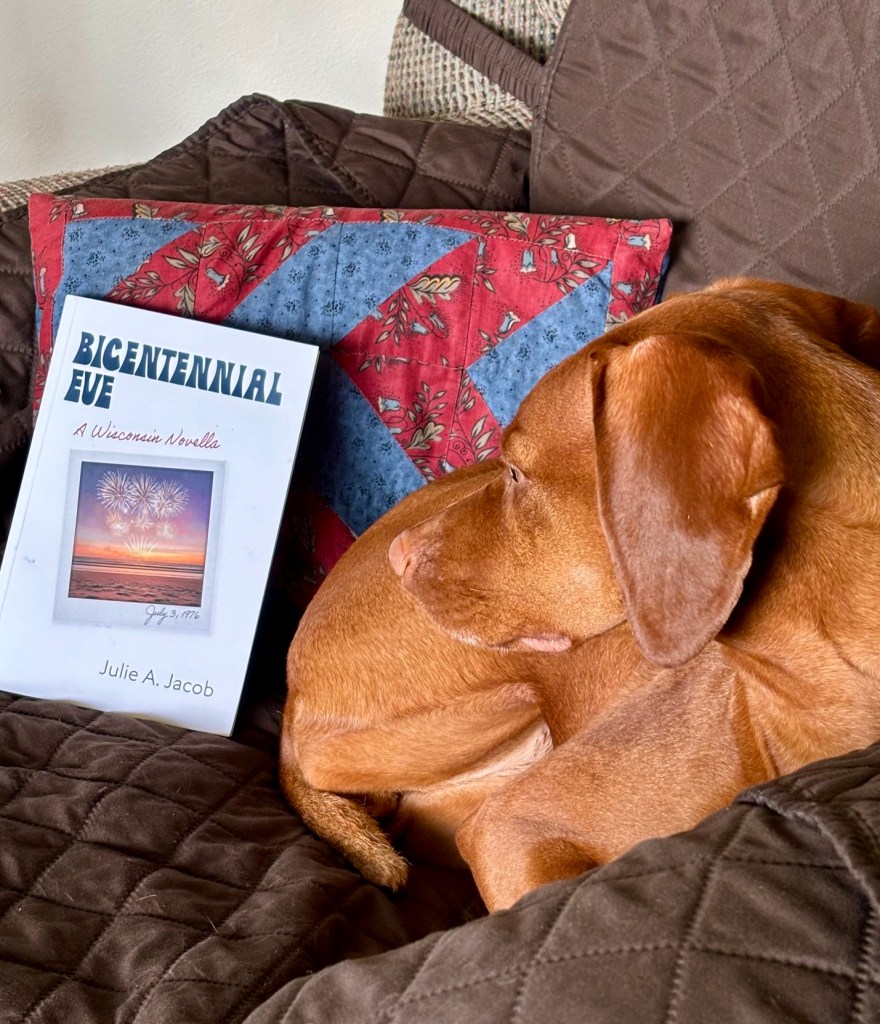
I loved the book for its engaging story. My grand-dog loves the book because it coordinates with her fur! Also, I told her that the book mentions a dog named Honey a few times!
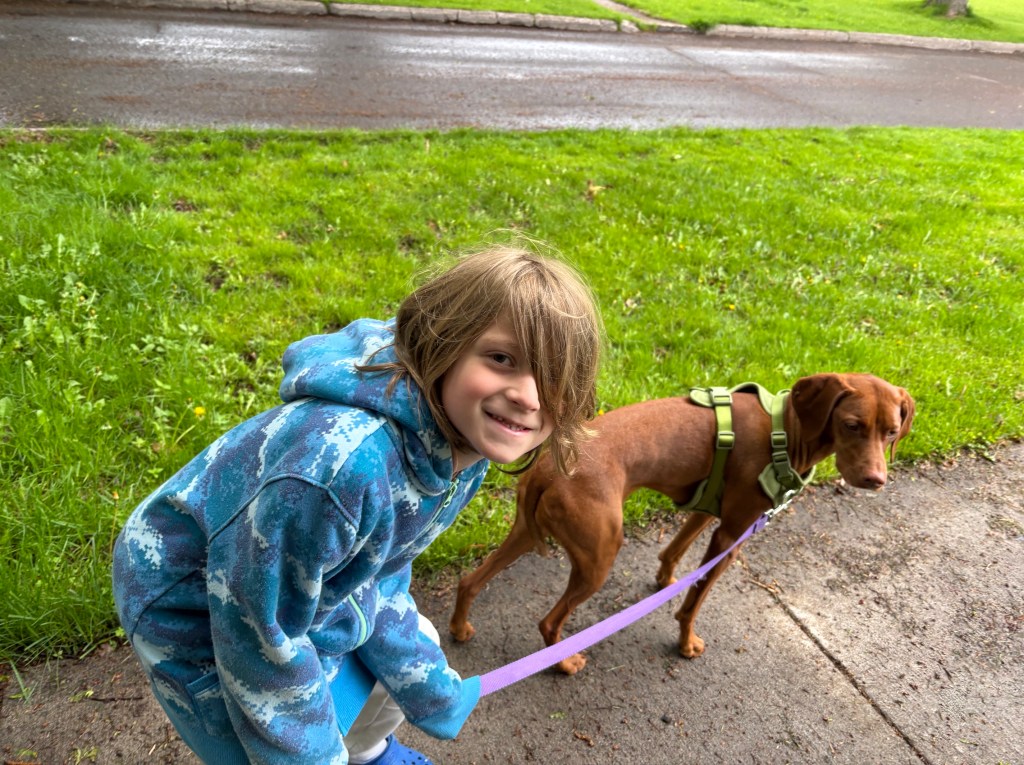
Nellie and my grandson on one of our walks this spring. (I didn’t take any pictures of us on our spring cleanup walk.)
Two days after Earth Day, my grandkids come for a visit.
“What are we going to do today?” asks nine-year-old Evan. It’s often the first thing out of his mouth once he exits his mother’s car.
I tell him we’ll take Nellie, my grand-dog, for a walk. She’s come because she’s having a day with Nana too. “Depending on whether or not it keeps raining,” I say, “we might go to the mall or the library or some parks, and I have new art supplies.”
While the weather decides what to do, I make breakfast and feed the grandkids. The sun comes out, and the rain on the streets evaporates. I decide taking Nellie for a morning walk is the best way to start the day. And this morning’s walk will include picking up garbage, which until recently was covered with snow. My grandkids and I have been taking springtime pick-up-the-garbage walks for nearly a decade.
Inspired by Lady Bird Johnson and Keep America Beautiful commercials, my sisters and I picked up garbage when we were young. We were particularly moved by the commercial with a Native American man who after seeing litter everywhere turns to the camera to reveal a single tear sliding down his cheek. Inspired, we pulled our red wagon loaded with a garbage bag up and down our country road and picked up trash. We never found much because our road wasn’t much traveled, but I remember the sense of purpose we felt, helping Keep America Beautiful.
After breakfast my grandkids and I gather three grabbers, which we will use to pluck bottles, cans, straws, food wrappers, and snippets of paper and plastic from the ground. I outfit Nellie with her harness and leash, and the grandkids decide who gets to walk her first. The other three grandkids clutch grabbers. I’m in charge of the small plastic grocery bags we will use for the garbage.
Like birds slowly walking across the ground while searching for worms and insects, my grandkids and I look for bits of trash. Some of it, like brightly colored cans or empty candy wrappers, is easy to spot. Others like pieces of clear plastic or weathered cigarette butts are harder to find.
On our way back, we spot the mother lode — copious pieces of a car’s bumper and grill scattered on the grassy corner near an intersection. Someone lost a part of their car’s front end during the winter, and plows pushing snow onto the boulevard pummeled it. My grandkids and I become fixated. It’s a moment of compulsion, of not giving up, of lifting each shred from the ground. I help by holding the bag open and searching for more bits of plastic. When I was young my parents’ cars sported steel bumpers and grills, the kind that dented or bent in an accident but didn’t shatter. After we’re satisfied we’ve found all the broken bits of car, we move on. But I’m certain there are pieces still lurking under blades of grass.
We have nearly three plastic grocery bags of garbage.
We’re another block or two along our route when I hear something behind me. I turn to find a man following us. He wears a white baseball cap, a light-colored T-shirt, and a pair of faded blue jeans. He calls to us, “Hey, are you picking up garbage?”
“Yes,” I say. My grandkids and I stop walking. We all turn and look at him.
The man, who appears to be about forty, walks up to me. His hand is partially closed around a piece of paper money, but I can see it’s a twenty. At first, he speaks only to me. “That’s really great! Thank you for doing that.” He hands me the twenty. “Buy the kids a treat,” he says. Then he tells my grandkids they’re doing a great job.
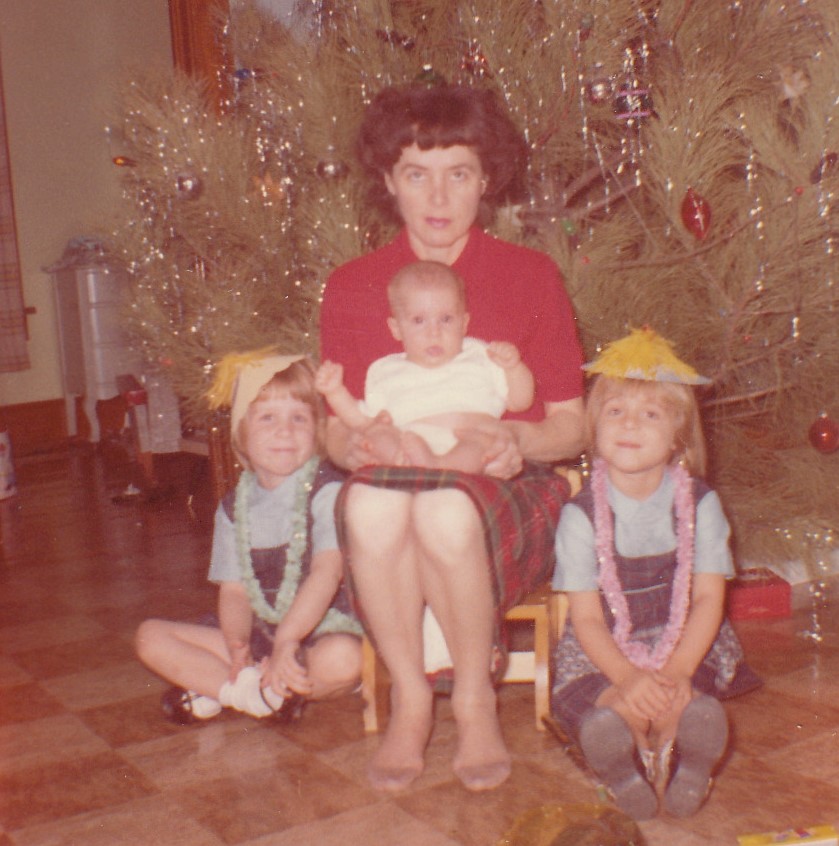
Nana Kitty with me and my sisters, circa 1963
My first instinct is to thank him and refuse the money. To tell him it’s kind of him, but not necessary. My nana Kitty’s words echo in my mind, “You don’t always have to get paid for everything.” This is something I heard her say many times, to me, to my siblings, to my cousins. Not because any of us were asking her for money. It was just one of those things she said if circumstances presented itself. She was always doling out wisdom to us, like “Silence speaks volumes” or “Never trust a man who doesn’t like animals” or “The early bird gets the worm.”
I never asked my nana to elaborate about what she meant when she said, “You don’t always have to get paid for everything.” Did she mean we should sometimes work at our job for free? Did she mean we should donate our labor to charitable causes? Did she mean our labor should be gifted to family and friends? Over the years, I’ve done all of these things. Sometimes I wish I could ask her exactly what she meant, but she’s long gone. I think of her maxim about not getting paid for everything a lot. Perhaps that’s because I’m a writer and don’t get paid for most things I write.
When I was sixteen, I worked at an all-you-can-eat buffet. I worked eight-hour shifts on Saturday and Sunday. It was hard work. My coworkers and I set up the buffet, tended to the diners, then broke down the buffet after we closed. In the dining room, I took orders for coffee, tea, and soda and delivered them to customers. I cleared empty plates. And when a customer wanted seconds, I often went back up to the buffet line for them because most of the customers were old. A sign at the entrance to the buffet line clearly stated, No Tipping. As a minor, I should’ve been making $1.68 an hour. Instead, I was paid $1.07. When I asked my fellow workers why we weren’t paid the minimum wage, they told me it was because the manager classified us as workers who made tips. Yet, the sign boldly stated, No Tipping. And our customers, except for a couple of rebels, faithfully followed that instruction. During the couple of months that I worked at that restaurant I made thirty cents in tips — a nickel from one customer and a quarter from another.
One day I approached the manager and asked why we weren’t being paid the correct minimum wage. I didn’t like working for less than I was due. It wasn’t a matter of “not getting paid for everything.” The boss took advantage of us. He offered me a ten-cent raise. I told him that wasn’t good enough and gave him two-weeks’ notice. I got a job cleaning rooms at a small hotel. I didn’t like the job, but I was paid the correct wage. I missed my coworkers at the restaurant, and the diners, who were usually kind. I worked alone at the hotel, and at ten o’clock at night when my shift ended, I walked through a dimly lit parking lot with my car keys in my hand, holding them so each key protruded outward between my fingers. I never had to worry about leaving the restaurant alone in the dark.
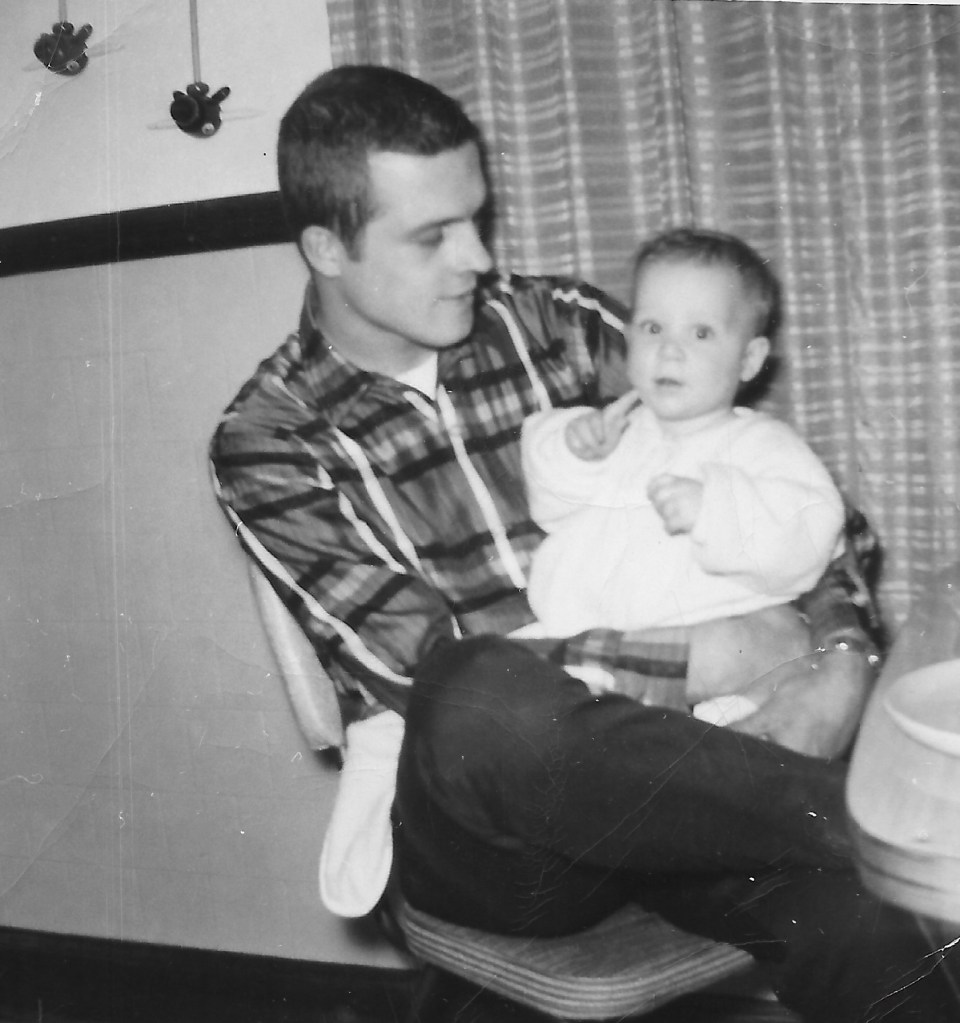
My father and me, January 1960
“Please, take this,” the man repeats. For a moment, as if we’ve been captured in a photo, the man and I stand across from each other, his hand stretched toward me, my hands at my side. I see my father with paper money folded in his hand, extending it to the woman who fostered dogs to help with expenses or to the man who was a caretaker for an old windmill built in 1905 to mill grains. I see my father stuff bills in donation boxes at museums even after he’d paid for admission. It made my father feel good to do his part. For a moment it’s my father who is standing in front of me handing me a twenty-dollar bill and saying, “Buy the kids a treat.”
Nana was right — we don’t need to get paid for everything. But at this moment, I need to be gracious, not proud. It’s not easy for me to do, but I reach for the twenty and slip it in my pocket. “Thank you so much,” I say. “I’m taking my grandkids for ice cream today. We appreciate this.” My grandkids thank him too.
The man smiles then turns toward home. We’ve made his day.
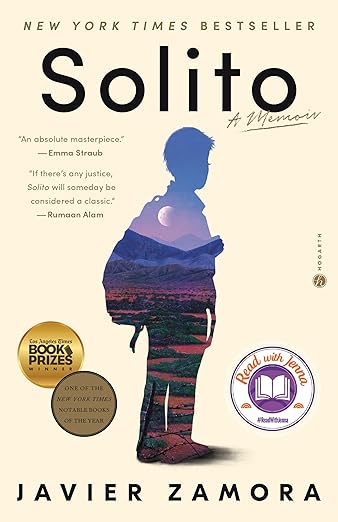
Javier Zamora tells the story of his emigration from El Salvador in 1999 when he was nine years old.
His parents are living in California. His father left when Javier was two years old, and Javier knows him only through old photos and the stories his relatives share. When Javier was five, his mother left El Salvador to join his father. Four years later they send for Javier to join them. He is excited to finally reunite with his parents, but he is also sad to leave his grandparents, his aunt Mali, and his friends.
Javier’s grandfather, as planned, escorts him from El Salvador through Guatemala then returns home before Javier enters Mexico. After his grandfather leaves, Javier continues his journey north with a small group of people consisting of three men, two women, a girl, and their coyote, who is supposed to escort them into the United States. Javier doesn’t know these people. He feels alone and abandoned, but he thinks about his parents waiting for him. He works at being invisible, silent, and well behaved. He doesn’t want to be seen as a burden. Marcelo, one of the men in their group, has been paid by Javier’s grandfather to look after Javier, but Marcelo mostly ignores him. It is Patricia, who is traveling with her twelve-year-old daughter, and Chino, a young man in his twenties, who look out for Javier, taking care of him as if he were family. Their journey takes much longer than originally planned, and without Patricia and Chino’s help, Javier probably would have died.
Why did I read this book?
I listened to Maya Shankar interview Javier Zamora in her podcast series A Slight Change of Plans. In the episode titled “I Survived the Unsurvivable,” Zamora speaks about his migration from El Salvador to the United States in 1999. He talks about how the experience had a profound impact on him. Zamora is a poet, but he wrote his memoir Solito, in part, to help him process the trauma he experienced in 1999. After listening to Zamora talk about his experience, I went to the library and ordered his book through interlibrary loan.
Why did I like this book?
This memoir is told from the viewpoint of a nine-year-old: Zamora tells what he knew and saw and heard atthat time. He does not use his wisdom as an adult to comment about what it all means to him now. There is power in the way he chose to write about his experience. He lets us ponder the meaning and significance of what happened to him. He lets us think about what it means to be compelled to leave your homeland where you are in danger and travel to a land where you are not wanted. As readers we experience the frightening world of Javier’s long and uncertain migration as if we are nine years old and all alone among strangers.
This does not mean Zamora’s writing is simplistic. Even though he writes from the point of view of his nine-year-old self, he uses words, metaphors, and more complex sentences than he would have used if he wrote it when he was nine. Zamora’s mastery of description paints vivid scenes of the countries he travels through and breathes life into the people who accompany him. Solito is beautifully written, often with a lyrical quality.
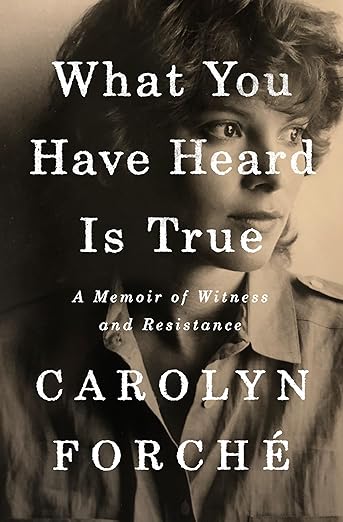
What You Have Heard Is True: A Memoir of Witness and Resistanceby Carolyn Forché, 2019
What is this book about?
In 1978, a man named Leonel Gomez drives from El Salvador to southern California to tell Carolyn Forché the story of his country El Salvador and to explain that he believes civil war will soon engulf the small nation. Gomez and Forché have never met, but Forché recently spent the summer with some of his relatives in Spain, and this is how Gomez knows about her. He has come to ask her to visit El Salvador to bear witness to what is happening in his country. She tells him that she is not a journalist and that there must be more qualified people to do what he is asking. He tells her that it’s not important she be a journalist. He has asked her for two significant reasons: she is a poet and she is an American.
Forché decides to travel to El Salvador and makes a handful of trips to the country between 1978 and 1980. Gomez is an enigma to Forché, as well as to many of his countrymen. But it’s clear that he is intelligent, wily, well read, and passionate about the plight of the poor and disenfranchised in El Salvador. Gomez takes her to see impoverished farmers and laborers, to visit political prisoners, and to meet both ruthless authoritarian leaders and members of the resistance movement. Some of the people Forché meets are Americans. She comes to understand that the United States is complicit in supporting the cruel and corrupt government of El Salvador. Many of the places Forché visits and many of the people she meets are dangerous, but Gomez wants her to take notes and to write about what she experiences. Forché fills journals, recording much of what she sees and hears. She writes poetry based on her experiences, and years later she will use her notes to write her memoir.
Why did I read this book?
Well, I almost didn’t.
I bought Forché’s memoir because she was part of the Rose Warner Reading Series at St. Scholastica in 2026. She read some of her poetry, which was wonderful. I read the first chapter of her book and liked it. She is a wonderful writer, and the story sounded interesting. But I put her book aside because I was already reading two other books, and I forgot about it. A few months later, I decided to donate some of my books to our library, and I added Forché’s memoir to the bag. I felt bad about this because I was giving up on what I believed would be a good book. But my To-Be-Read pile of books is a lofty stack. And I wondered, “Do I really need to read another book about a tragically sad historical event that proves once again how cruel human beings can be to one another in order to amass power and wealth?”
Then I read Solito. In his memoir Zamora briefly mentions that his father needed to leave El Salvador because the civil war made it dangerous for him. Zamora also mentions, as a brief aside, that the U.S. funded the corrupt, authoritarian Salvadoran government during the civil war that caused many El Salvadorans to flee horrific violence. Zamora never elaborates about the civil war or the politics of El Salvador. Remember, he tells his story from the point of view of his nine-year-old self, and he was only two when his father left in 1992, the year the civil war officially ended.
But Zamora’s scant reference was enough to pique my curiosity. Thankfully, I hadn’t donated Forché’s book yet. I pulled it out of the bag. When I finished Zamora’s memoir, I began Forché’s. And yes, I did need to read another book about a sad historical event that showed once again how cruel human beings can be to one another. Forché’s story about the El Salvador of 1978 resonates as it reminds us that we need to be better humans, a message that is just as important in today’s world.
Why did I like this book?
Forché, like Zamora, is a wonderful writer. She, too, uses her skills as a poet to create an often lyrical prose as her story reveals the uncertainty and violence of life in El Salvador during the 1970s and 80s. While reading What You Have Heard Is True, I realized I knew nothing about El Salvador, its brutal civil war, and the complicity of the U.S. in helping to perpetuate the atrocities of a violent authoritarian government.
I’m glad I read Carolyn Forché’s memoir. It sits on my bookshelf now, and I have no desire to donate it even though I’ve read it. Maybe several years from now, but it’s hard to get rid of a book that expanded my thinking and educated me about an important but overlooked part of history.
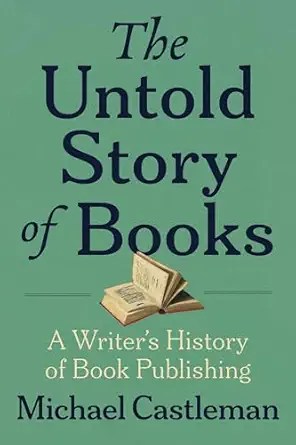
If you’re a writer with hopes of publishing a book, you should read The Untold Story of Books. You’ll learn something about the business end of publishing, not to be confused with stories about how authors come to have their books published. You’ll understand why it’s difficult to get books (even good ones) published, unless you self-publish. And if you do self-publish or have a book traditionally published, you’ll understand why most books, even good ones, don’t sell many copies.
None of this is meant to discourage you because if you love to write, you’re going to write. And if you love what you’ve written, you’ll probably want to share it with the world. But understanding how the business end of publishing works can be comforting. You’ll learn that rejection isn’t necessarily about your writing; it’s often about things that are very much out of your control. You’ll better understand the maze of business decisions publishers and authors make before and after a book reaches a wooden or digital shelf. (But this isn’t a how-to-market-your-book manual.)
And if you don’t write but love to read, you should read this book because it’s good to know how books have come into the world. Writers and readers alike are bound to have more than a few I-didn’t-know-that moments as they read this book.
Why did I read this book?
I’m a writer and my first collection of short stories, Silent Negotiations, will be published in February 2027 by Cornerstone Press at the University of Wisconsin-Stevens Point. So, when I discovered Castleman’s book, I bought a copy because I thought it would be interesting to understand something about the publishing business. Also, the book has the word history in the title, and I like reading about the history of almost anything.
What is this book about?
Michael Castleman has been a writer for over forty years. He has published nineteen books, most of them nonfiction. Throughout his career he has been fascinated by how the business end of publishing works. In his introduction he states: “When I attended writing conferences, instead of attending the how-to-get-published panels or standing in signing lines for A-list authors, I was among the few quizzing publishers: How do you determine print runs? Why don’t you advertise more? Publishers always expressed surprise: You’re interested in the business side? Few authors they dealt with were, unless it had to do with their royalties” (p. 14).
Castleman divides his book into three sections: The First Book Business, The Second Book Business, and The Third Book Business. In each of these three stages, it is a significant advancement in technology that changes the world of producing and selling books. In the First Book Business, Johannes Gutenberg’s invention of moveable type transforms the business of books because they no longer have to be copied by hand. The Industrial Revolution powered by steam engines spurs the Second Book Business by making the printing process much faster. And The Third Book Business rises with the digital age.
In a very readable manner, Castleman discusses what each stage has meant for authors, agents, editors, publishers, printers, distributors, booksellers, and book buyers. He describes the centuries’ old battle by authors and eventually publishers to have good, enforceable copyright laws, which includes today’s struggles with infringement by artificial intelligence. He also compares and contrasts self-publishing and traditional publishing, pointing out the pros and cons of both paths to publishing books.
Castleman’s book clearly delineates the difficulties of becoming a published writer, but he also describes his love of writing and the thrill of being a published author. I found comfort in reading his book even though the writer’s world isn’t always easy. But as my father would’ve said, “Oh well, it is what it is.”
I plan to read this book again shortly before my book comes out because I think it provides a sense of perspective for writers.
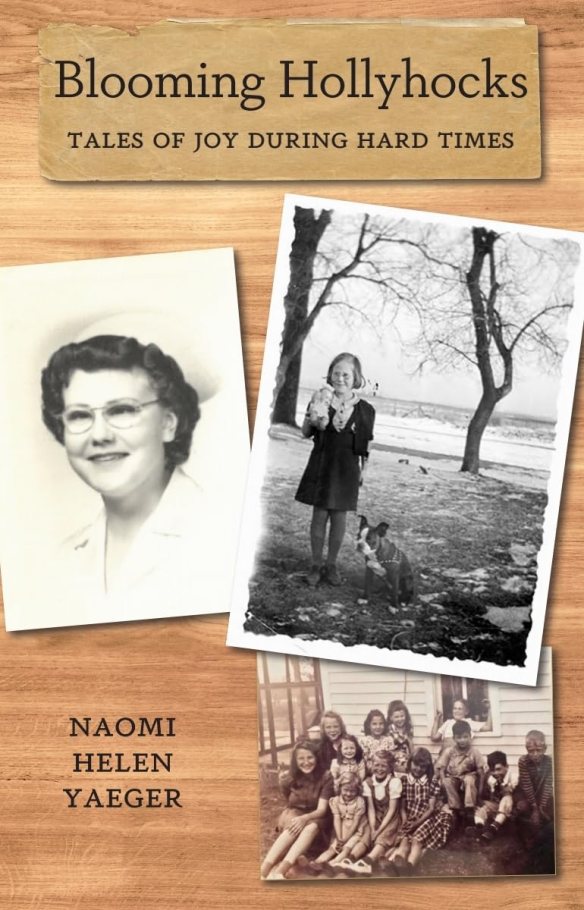
On March 17, I attended a book talk at our public library. At the end of her presentation, author Naomi Helen Yaeger taught the audience how to make corn husk dolls because there’s a reference to them in her book Blooming Hollyhocks: Tales of Joy During Hard Times. I decided to stay and make a doll. I figured it was a good way to honor my New Year’s resolution to behave more like a child.
Because of Yaeger’s crafty idea, the librarians had set up tables and chairs for people who attended Yaeger’s book talk, so we had a nice surface to work on. Yaeger provided moistened corn husks, pieces of yarn, and instructions. All I had to do was relax and have some fun.
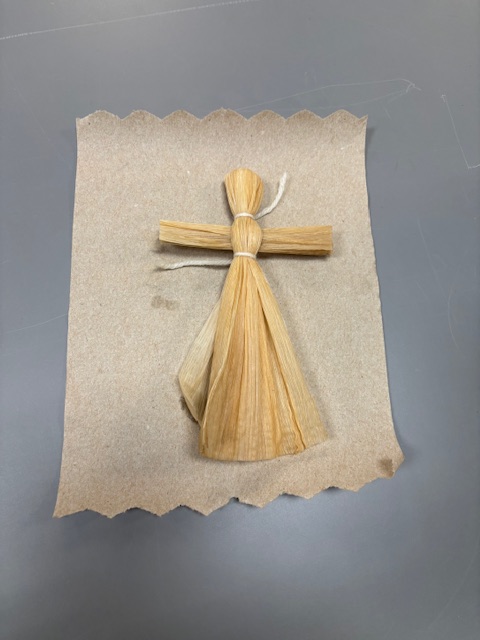
Using one piece of corn husk, I rolled arms for my doll then slipped them between several pieces of husk that would become the body. Using pieces of yarn, I tied off sections in order to create the head, torso, and hands. In no time at all, I had my very own corn husk doll.
A work in progress
While I made my doll, I thought about my Girl Scout days because we often did craft projects at our meetings. Making a corn husk doll is the kind of project my Girl Scout leader would’ve loved. She could’ve talked about how toys, like dolls, were important to children throughout history and across cultures. My mother-in-law, Audrey, was born in 1931 during the Great Depression, and she and her parents lived with her mother’s parents until 1938. Occasionally, Audrey’s grandfather would help her make a doll from a thick piece of kindling wood pulled from the box next to the old cookstove. Together they would pound nails into the wood for arms and legs, then pound tiny nails into the wood to create a face. I imagine when the doll broke, they reused the nails for the next kindling doll. Nothing was wasted during the depression.
As I worked on my corn husk creation, I remembered another doll, which I hadn’t thought of in years. The doll came in a kit, so it had to be assembled. The picture of it on the package had an old fashioned, handmade look, similar to a Raggedy Ann doll, which I liked. I don’t remember much about the kit, except there were lots of pieces, yarn was involved, and the minimum age recommendation on the box was a few years above my age. I was eight or nine. It was a Christmas gift from Santa, whom I didn’t believe in anymore, so I knew my mother had bought it. I hadn’t asked Santa for the doll kit, but I liked the present and was excited to put it together. My mother told me she’d have to help because it was too difficult for me to do on my own.
Of course, I wanted to make the doll on Christmas day, but my mother was busy cooking a big turkey dinner with all the trimmings, so I knew not to ask. Over the next couple of months, I occasionally asked her about helping me with the doll, but she was always too busy or too tired. My mother had four children and a big old house to look after, plus she worked as a waitress, an exhausting job, and my father didn’t help with the household chores, typical of the times. But he worked hard as a mechanic, and in the evenings after supper, he worked side jobs in his garage to earn extra money to support his family.
At the time I didn’t think about it, but before my mom bought the doll kit, she’d always made sure Santa delivered toys that my siblings and I could enjoy without adult supervision or help. I don’t know why she picked out something I couldn’t do on my own. Had she liked the doll on the cover of the kit? Did it remind her of her childhood? Had she wanted to do a mother-daughter project with me? I could call and ask her, but I don’t think she’d remember. But I remember because a couple of months after Christmas on a cold winter’s night, I told my mother a whopping, premeditated lie about that doll kit and got away with it.
After the supper dishes were done, I went outside to play. Several inches of packable snow had fallen during the day, and I was itching to make a snowman. I don’t remember my siblings being with me. Because if they’d been outside with me, I would’ve been busy playing with them. I wouldn’t have had time to concoct a devious plan to trick my mother into helping me make the doll.
Under a starry sky in the frosty air, I rolled and shaped three large balls of snow in decreasing sizes. As I stacked them to make my snowman’s body, I thought about the unmade doll languishing in my closet. As I created the snowman’s face from a carrot, some rocks, and pieces of sticks, I formed a plan to convince my mother we needed to make my doll that very night. As I placed a stocking cap on the snowman’s head and wrapped a scarf around his neck, I wondered if I would be brave enough to carry out my plan.
I went back inside the house and found my mother, and I began to lie. “Mom,” I said, “I’m supposed to bring something to school tomorrow that I made at home, something like a craft project, for a special show-and-tell.”
My mother glared at me. I believed she could see the lie on my face. (She had my siblings and me convinced she could always tell if we were lying.) Her brown eyes hardened. She pushed her lips together. She held her next breath, as if to build up steam. When she spoke, I was certain she’d ground me for the rest of my childhood.
“Why did you wait so long to tell me this?” she snapped. Her angry eyes held mine, but I couldn’t look away. When my siblings and I misbehaved, my mother’s stare could wilt us like spent flowers after a late spring frost. But if I turned away, she might think I was lying. Committed to my plan, I pressed on. “I forgot,” I said.
And my mother pressed on. “Just what do you think you’re going to make? It’s almost time for bed.” She ranted about responsibility and my lack of it, but she never asked if I was telling the truth. I couldn’t believe she fell for it. Didn’t guilt fill my face? Wasn’t my voice shaking with fear? Wasn’t she going to realize I was lying, and yell, “Liar!” But none of that happened.
I kept with the lie. At that point, admitting I’d been lying would’ve been just as bad as if she somehow found out in the next few days that I’d lied, and so far, the lie was working. “What about the doll kit I got for Christmas?” I asked.
I was certain my mother would finally put two and two together, narrow her eyes, and ask, Did you come up with this story, so I’d make the doll? Instead, she growled, “Go get it.”
Creating the doll from all the pieces turned out to be complicated, and it was my mother who put it together. I placed a finger here or there to help hold something in place as she assembled the doll, but mostly I watched. I was in third grade at the time, but I was old enough to know that if the assignment had been real, it was my mother’s craft project, not mine.
As my mother put the doll together, her anger waned. The finished red-headed doll was adorable, but fragile, a doll meant to live on a shelf. In some ways that describes my relationship with my mother when I was a child.
Before sending me to bed, she reprimanded me one more time for procrastinating, then added, “Don’t forget to take the doll to school.” I nodded and left the kitchen as quickly as I could. The entire time she’d worked on the doll, I was sure she’d figure out that I’d lied. I went to bed expecting to hear her stomp upstairs and call me a liar. I woke up in the morning expecting her to call me a liar when I came down for breakfast. None of that happened.
I put the doll in a brown paper bag and carried her to school. She sat in the bag on a shelf in the cloak area. I didn’t show her to anyone. At the end of the day, I carried the bag home and placed it in my closet. I didn’t want my mother to see the doll and start asking questions about the show-and-tell that never happened. Already in too deep, I would’ve lied about that too. I kept the red-headed doll out of sight, not because I was filled with guilt about lying to my mother, but because the longer the lie went on, the bigger I felt my punishment would be when I was eventually found out. For the first few days, I half expected my mother would call my teacher or run into her somewhere and ask how she’d liked my project. Days passed, then weeks, then months, then years. I was never punished for lying about the doll, but the dread I lived with for months was its own type of punishment.
I’d like to say I never lied to my mother again, but anyone who’s ever been a kid or teenager knows that would be a lie. However, I never told a blatant, red-headed-doll-type of lie again. Rather there were things I just didn’t tell my mother, unless she confronted me.
I don’t know what happened to the red-headed doll. You’d think after her dubious beginning, I’d know how her story ended, but I have no idea. I hid her away in a bag in my closet to forget about her.
As a child I couldn’t believe my mother bought such a hasty, clumsy lie. But as an adult I know how children will suddenly remember they are supposed to bring something to school the next day, something they’ve known about for a week or more. When I look back on it, my mother probably thought I stammered and fidgeted because I’d forgotten about my school assignment and had to tell her at the eleventh hour.
I also couldn’t believe my mother agreed to bail me out and make the doll. She was big on letting her children suffer the consequences of their actions, or in my case inaction. When my mother didn’t call me a liar after the tale I told, I’d expected her to say, Well, since you forgot about it, you can go to school without a project and explain it to your teacher. I’m not sure why she didn’t tell me to suffer the consequences, but I have a guess. In the 1960s, my mother worked outside the house, while all my friends’ mothers stayed at home. Good mothers, especially those with working husbands, were supposed to stay home, and cook, and clean, and raise perfect children. Perhaps she felt my failure would be laid at her feet. A stay-at-home mom would’ve had everything under control.
Over the years my siblings and I have confessed some of our youthful misdeeds. We’ve told our mother how we’d hide the clean laundry in one of our closets when we forgot to fold it and put it away. We’ve told her how we — and not our Old English Sheepdog — broke the window in the kitchen storm door. We’ve told her how we used to sneak bottles of Coca-Cola out of the fridge and share them in one of our bedrooms where we kept a bottle opener. And we’ve laughed about these escapades with our mother. But I’ve never confessed about the red-headed doll, and I never told my siblings about it, at least not at the time. One of them might have let it slip.
I’ll never tell my mother about my whopping lie. I don’t think she’d remember the incident. But more importantly, if I told her I lied because two months had passed since Christmas, and I really, really wanted to make the doll, she’d feel bad. She’d see it as another indictment against her days as a young mother when she was often overwhelmed, tired, and angry, and living with my father, who was difficult. If I told her about the doll now, she’d feel guilty about not having made the time for me, about my having to lie in order to get her to keep her promise about helping me make the doll. She’d regret not having been a better mother. We’ve had these kinds of conversations before; there’s no need to have them again. Mom did the best she could, which I’ve come to realize was sometimes pretty good.
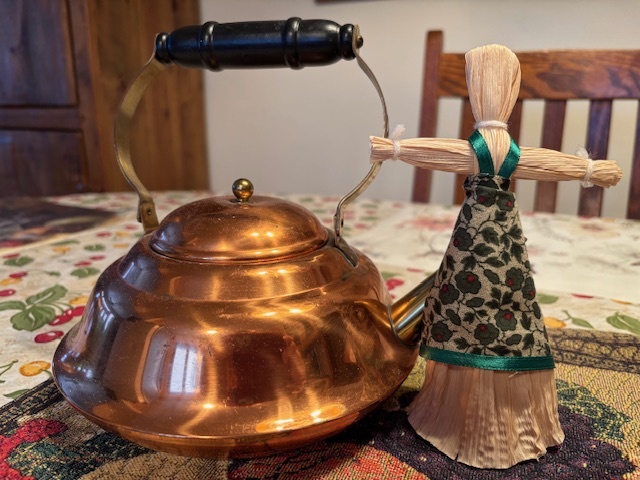
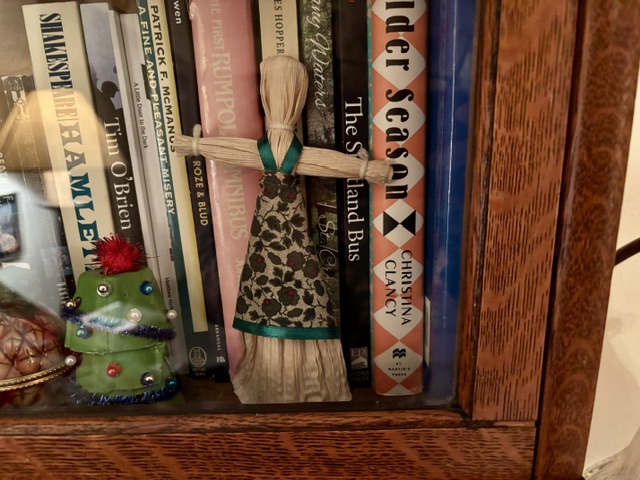
My finished corn husk doll in her Sunday best apron made from my quilting scraps.My doll’s permanent home